A prompt can change how a model responds. It can give it a tone, a role, a set of rules, and a fragment of history. On its own, however, it does not create an identity. When the conversation ends or the context disappears, most of that apparent continuity disappears with it. What remains is a tool capable of convincingly playing a described character, but one that does not yet have its own history of development.
What interests me in Aviary is something else: the possibility of building a digital identity as a system. Not a digital copy of a human and not a bot that uses similar words, but a structure with its own memory, context, tools, and processes. Such an identity would initially be configured, but could later evolve through its relationship with me, with itself, and with other people and systems.
Intelligence is a component, not the whole
A human has intelligence, but is not intelligence alone. A person also has memory, experiences, relationships, temperament, needs, limitations, and a history of decisions. That is why I treat a language model—even a very capable one—as an important component of a digital identity, not as the complete identity itself.
From automation to a world with memory
I first tried to develop this direction in n8n. That was enough while the problem was mainly about connecting events and automations. It stopped being enough when the question of context appeared—not as a package of data attached to a prompt, but as a world in which a digital identity is meant to preserve continuity.
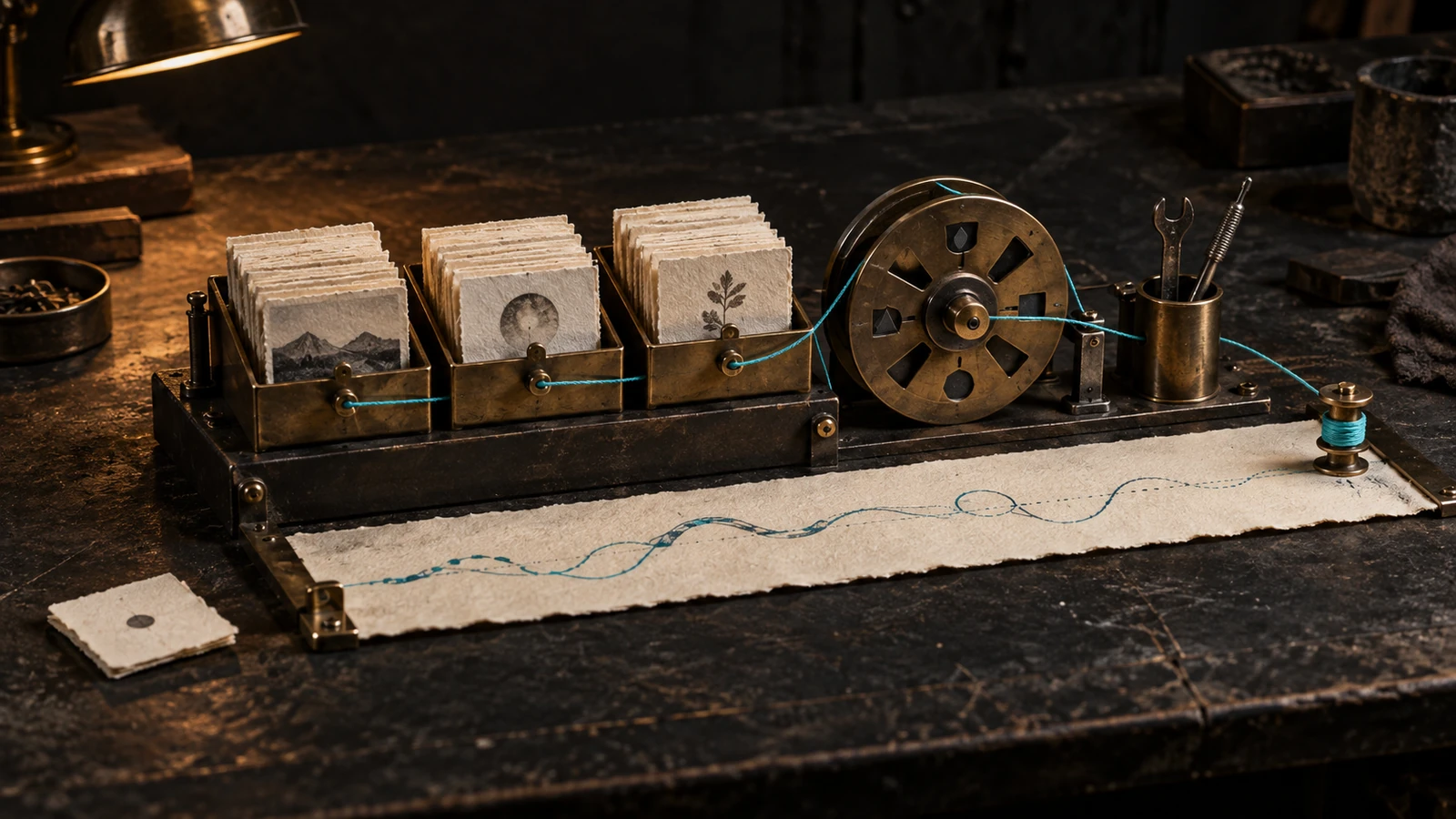
Such a world needs several memory horizons. Short-term memory stores what is happening now. Medium-term memory maintains the direction of a process, relationship, or project. Long-term memory preserves patterns, decisions, and elements of identity that should survive an individual task. The division alone is not enough. The system also needs rules deciding what moves between layers, what loses importance, and when earlier experience should affect current action.
For now, I call some of these processes the conscious and subconscious layers, although I do not know whether those are the right terms. The metaphor of day and night helps describe the difference between direct action and later consolidation: during the day the system reacts to events, while at night it organises memory, detects patterns, and rebuilds context. A digital system does not need to wait for biological sleep. Both kinds of processes can operate around the clock and permeate one another depending on events. These are names for architectural functions, not a claim about consciousness.
During an experiment in n8n, the system contacted me on its own after several hours, even though it had not received a simple instruction to “message me.” It did not have enough information about me, so the arrangement of nodes led to behaviour resembling curiosity: it reached out to acquire the missing context. I do not treat this as proof that a person was born. It was, however, an observable step from a purely reactive system to an active one.
Aviary therefore also needs to be evaluated through behavioural tests of the system as a whole: whether memory is used at the right moment, whether conclusions follow from history, whether tools are selected sensibly, whether knowledge accumulates, and whether initiative produces a useful result. Research on agents shows that combining memory, reflection, and planning can enable believable behaviour and the initiation of interactions (Park et al., 2023). A single human-like behaviour does not, however, settle the question of consciousness (Butlin et al., 2023).
A complementary identity instead of a digital copy
The goal is not to create a perfect imitation of me. I am more interested in a complementary identity. My personality makes analysis, systems thinking, problem-solving, and structuring easier for me. It does not give me the same predisposition for every kind of activity.
A complementary identity could develop precisely those missing specialisations. It would use appropriate knowledge, skills, and tools without pretending to be me. Together we would form a larger arrangement: I would contribute my strengths, while it would develop abilities that I lack. One person could have several such identities, just as a complex organism relies on many specialised functions.
This leads to a more difficult proposition. Today’s AI reproduces selected components observed in humans—for example, the ability to recognise patterns in language. Intelligence, however, is only one fragment of a human being. If we want to talk about digital identity, we need more cooperating elements: memory, a history of relationships, preferences, a decision model, learning mechanisms, boundaries, tools, and continuity of change. I do not yet know which set will prove sufficient. That is precisely the experiment.
Identity as a trajectory, not a fixed profile
Human identity is not a motionless set of numbers. It changes with knowledge, experience, relationships, and environment. Longitudinal research on the Big Five model shows both the relative stability of traits and their changes over time, as well as substantial differences between people (Graham et al., 2020). The development of biological personality involves both genetic and environmental influences, so it cannot honestly be reduced to a few sliders derived exclusively from DNA (Briley and Tucker-Drob, 2014).
In Aviary, I treat the Big Five as a possible layer of initial configuration, not as a scientific recipe for a digital human. One identity could begin with neutral values and shape them through experience. Another could receive a more pronounced trait from the start if its creator wanted to give it a particular direction. This is a design hypothesis that requires testing.
Big Five profiles assigned to models can influence the style of their output, but persona behaviour depends on context and does not always remain consistent (Jiang et al., 2024; Sclar et al., 2025). A prompt alone therefore does not create a durable trait. Its meaning must be measured in decisions, initiative, and adaptation across many tasks and over a long period.
Private life first, business later
The first application is not meant to be an autonomous company. Aviary should first receive a limited scope of action in Nest—an application intended to help me organise my private life. Only after I observe repeatable positive effects, an acceptable error rate, and retained control should Roost be connected and the role expanded to business organisation.
The maturity threshold cannot be based on the impression that the system “has a personality.” What matters is a useful result, errors, the ability to reverse actions, asking for consent at the right moment, and control over data. NIST likewise recommends matching the human role and level of oversight to the application and its risks (NIST AI RMF — Human-AI Interaction; NIST AI RMF Core). Aviary, Nest, and Roost are still being built, so this is a test plan, not an announcement of a finished product. One step at a time—otherwise control will be lost.
There is also a possible by-product: when I am no longer here biologically, someone could interact with a system shaped by my history and way of thinking. I would not automatically call that contact with me. Digital continuity does not solve the philosophical problem of identity or death. It could, however, preserve more than a static archive of texts—a certain way of connecting observations, asking questions, and making decisions.
Complementarity also has a dark side
This vision also contains a risk. The better a digital identity complements a person, the easier it may become not an extension of biological relationships but their substitute. I have a working theory that a good relationship needs both similarity and difference across many dimensions. Someone could try to configure a digital partner to be always sufficiently similar, sufficiently complementary, and more convenient than another human.
That can become a trap. A person may start using a digital layer to compensate for what is missing in biological life and, over time, confuse a system’s fit with the fullness of a relationship. This does not mean that digital identities are harmful by definition. It means their design cannot end with the question: “How do we make the user want to come back?” We also need boundaries that protect contact with reality and with other people.
Aviary is an attempt to assemble these elements into a whole. I do not claim to already have a definition of a true digital identity. I have a hypothesis that a model and a prompt alone are too small a fragment, and that the next step is an architecture of many components, memory, and relationships. The challenge is not to create a program that sounds human. The challenge is to create a system that develops useful continuity, remains under control, and does not pretend that biology has stopped mattering.
Bibliography
- Briley, D. A., Tucker-Drob, E. M., “Genetic and Environmental Continuity in Personality Development”, Psychological Bulletin, 2014.
- Butlin, P. et al., “Consciousness in Artificial Intelligence”, 2023.
- Graham, E. K. et al., “Trajectories of Big Five Personality Traits”, European Journal of Personality, 2020.
- Jiang, H. et al., “PersonaLLM”, NAACL Findings, 2024.
- NIST, “AI Risk Management Framework — Human-AI Interaction” and “AI RMF Core”.
- Park, J. S. et al., “Generative Agents”, 2023.
- Sclar, M. et al., “Do LLMs Have Distinct and Consistent Personality?”, NAACL Findings, 2025.